

 Write an Email
 Share
ShareWhitechapel is a neighbourhood in London’s East End, and in the autumn of 1888 it became the setting for the world’s most famous unsolved criminal case. Between August and November, five women were murdered there. The crimes were never solved, the killer was never identified, and the investigation has never formally closed. More than a century later, the streets where those events unfolded are still part of London.
Many of the streets, buildings, and alleyways from 1888 still exist today. Others were lost to the Second World War, post-war redevelopment, and the natural evolution of the city over the last century. Even so, enough of historic Whitechapel remains that walking the neighbourhood with an expert guide is a genuine encounter with the places where the case unfolded, rather than a reconstruction of them.
What Whitechapel Looks Like Today
Whitechapel in 2026 is a working neighbourhood in inner East London. It is not a preserved historic district. The markers of Victorian London are present but not obvious — you have to know where to look.
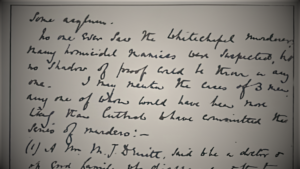
A Ripperologist who has spent years with the original Scotland Yard files knows which corner of which alley corresponds to which document, which building was standing in 1888, and where the original geography can still be felt even when the structures that defined it are gone. Standing in the actual geography of the case changes how you read it. It stops being a story and becomes a place.
What Survives from 1888?
Gunthorpe Street — known as George Yard in 1888 — retains its Victorian character: narrow, enclosed, the kind of passage the East End produced in abundance before redevelopment cleared most of them. It is one of the few alleyways in the area that gives a genuine sense of what the neighbourhood’s back passages looked like during the investigation.
Christ Church Spitalfields, designed by Nicholas Hawksmoor and completed in 1729, frames the northern edge of the neighbourhood. It predates the murders by more than 150 years and provides an architectural anchor that makes the depth of the area’s history feel continuous rather than distant.
The Ten Bells pub, at the corner of Commercial Street and Fournier Street, is still operating under its Victorian exterior. Several of the Canonical Five were known to have frequented it. Entering now, the distance between 1888 and the present narrows in a way that the written record alone cannot produce.
Altab Ali Park — where every Jack the Ripper Tour departs — contains the memorial to St Mary’s Whitechapel Church and carries its own layered history. Named after Altab Ali, a Bangladeshi garment worker murdered nearby in 1978, the park’s history does not begin or end with the Ripper case, and neither does the neighbourhood around it.
What the Blitz and Redevelopment Erased
The original Whitechapel of 1888 was far more densely built than what exists today. The network of courts, common lodging houses, and back passages — the geography that made surveillance nearly impossible — was substantially dismantled by German bombing during the Second World War and by post-war slum clearance.
Several specific addresses associated with the Canonical Five no longer exist. Dorset Street, where Mary Jane Kelly was killed on November 9, 1888, was demolished in the early twentieth century and does not appear on any current map. The Jack the Ripper Tour places those missing locations within the surviving street geography and explains what stood at each point and why it matters to the case.
What Autumn Brings to the Experience
The tour runs every night of the year, and no season is the wrong one. But autumn in Whitechapel has a quality that is specific and worth naming.
The evenings shift. By September, sunset in London is around 8:00 PM, so the tour begins just before dark and the light fades as the route progresses. By October, the 7:30 PM departure is well into the night. The air cools, the streets settle into a quieter rhythm, and the small group of 20 feels more intimate as the neighbourhood around it moves at a different pace than peak summer.
Summer works too — the Ripperologist brings the same depth to every departure regardless of season. Autumn is simply different: unhurried, quieter, and harder to forget.
Walk Whitechapel Tonight
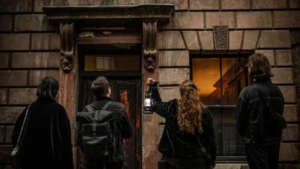
Several of these streets still exist. Several do not. Understanding which is which — and what each one meant to the case — is exactly what a Ripperologist guide is there for. The Jack the Ripper Tour departs every night at 7:30 PM from St Mary’s Whitechapel Church Memorial in Altab Ali Park, East London. Arrive at 7:15 PM and look for the yellow Carpe Diem Tours sign.
Tickets from €25. Private bookings through sales@carpediemtours.com. For those continuing into the City of London after dark, the Ghost Tour London departs nightly from Charterhouse Square. Book at jackrippertour.com.
Frequently Asked Questions
Can you still walk the Jack the Ripper streets in Whitechapel? Yes. Several locations from 1888 still exist, including Gunthorpe Street (formerly George Yard), the Ten Bells pub on Commercial Street, and much of the surrounding streetscape. Some locations were destroyed during the Second World War or cleared in post-war redevelopment. The Jack the Ripper Tour visits the surviving sites every night at 7:30 PM.
What survives from 1888 in Whitechapel today? Among the surviving locations: Gunthorpe Street (formerly George Yard), Christ Church Spitalfields, the Ten Bells pub at the corner of Commercial Street and Fournier Street, and the site of St Mary’s Whitechapel Church, now Altab Ali Park. Much of the dense lodging-house network of 1888 was cleared during and after the Second World War.
What happened to the specific crime scene addresses? Some survive and some do not. Dorset Street, where Mary Jane Kelly was killed on November 9, 1888, was demolished in the early twentieth century and no longer exists. The Jack the Ripper Tour places missing locations within the surviving street geography and explains what stood at each point.
Is Whitechapel safe to visit today? Yes. Whitechapel is a working neighbourhood in inner East London, accessible by Underground at Whitechapel station (District, Hammersmith and City, and Elizabeth lines). The Jack the Ripper Tour runs every night, rain or shine, with a maximum group of 20 guests. It departs at 7:30 PM, so arrive fifteen minutes earlier and look for the yellow Carpe Diem Tours sign at St Mary’s Whitechapel Church Memorial.
Is there more to see in the area beyond the Jack the Ripper sites? Yes. Spitalfields Market, Christ Church Spitalfields, and the Ten Bells pub all have their own distinct histories. For those who want to continue into the City of London after dark, the Ghost Tour London covers a separate route through historically significant locations including Charterhouse Square, Smithfield Market, and The Clink Prison.
 +300 Five-Star Reviews